We thought we’d offer you a contribution from one of our Three Speech regulars as we’ve not had one in a while. If anyone else has got something that they want to get off their chest, send it this way and we’ll get it up on the site.
I think that storylines have been massively overdeveloped in many recent games and I think that recently the Tomb Raiders: Anniversary, Legend and (to a lesser extent) Angel of Darkness are examples of games that have suffered because of this. It seems to me that as the games industry has matured, lessons have been taken from the movie industry regarding narrative structure. I believe this to be entirely the wrong approach.
Playing a game is an active pastime, as opposed to watching a movie, which is essentially a passive pastime. The important word here is “playing”. When we are playing a game (any game, not necessarily a video game) we are exercising our imaginations. When we are watching a movie, our imagination plays a role but it’s much more passive. We’re enjoying the ride courtesy of someone else’s imagination. As such, the narrative structure of a good game needs to be much less tightly controlled than that of a movie.
In the early to mid Eighties some of us played Elite. It involved moving a few dozen (and I mean that literally) primary-coloured lines around the screen. In order to translate that into a game, imagination was required. Once that was added, we were each on the bridge of our very own starship, trading across interstellar distances and running the gauntlet of police, pirates and hostile aliens! The content of Elite provided maybe 10% of the game. The other 90% came from our imaginations. Not everyone was able to provide that 90% and so computer gaming was quite a niche pastime, but those that could were rewarded with an incredible and immersive experience.
Fast forward to the start of the PlayStation era. By this time the capabilities of the various game platforms had improved beyond recognition. Less imagination was required in order to access the games. I would say that content provided around 50% of the game while the player’s imagination provided the other 50%. Games like Tomb Raider, Doom and Quake had minimal storylines but that was OK. Gamers brought their own imagination. Everyone played a slightly different game. Did Lara slaughter every animal that crossed her path or did she only kill where she couldn’t avoid it? Core weren’t saying. It depended on who was actually playing the game at the time. Every player brought their own version of her back-story. Her minimal biog was probably due to it being considered unimportant. In fact, it’s very minimalism was probably vital to the game. I would say that this balance (enforced by hardware limitations of the day, admittedly) between content and imagination gave us a “Golden Age” of video games.
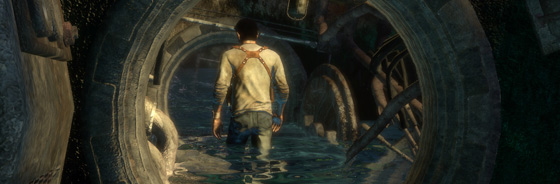
Since then, the games industry has ballooned out of all proportion - the hardware is awesome, as are the budgets for producing the games, and I believe that this is where the problem lies. Big money requires that every little detail be taken care of. A lot of games are so overproduced that there’s not enough room left for imagination anymore. Everything’s scripted. Content accounts for maybe 90%, while imagination is left with a paltry 10%, which is why a lot of today’s games feel more like movies. It can be done well, but you need to define absolutely everything. Japanese RPGs are an example of where this approach is an asset. I don’t believe that everything is lost, though. There are a few games in production where the designers are going out of their way to increase the imagination quotient, while using the current technology to improve the quality of play.
LittleBigPlanet is a good example and I really wish it well. If it succeeds, then expect more games with little or no storyline. Expect games that actually require you to exercise your imagination. I hope that games producers realise there’s more to a gamer than a pair of thumbs. I hope they find a way to give us storylines that allow our imaginations to play. Let’s hope so, because we could be seeing the dawn of a second golden age.
By Calvin Davidson