SUPERCOMPUTERS PART 3: THE GRID
Posted in: PS3 NEWS
In the third of a series of pieces about supercomputing, Dazed & Confused technology editor Chris Hatherill talks to CERN engineer François Grey about The Grid, a next-level internet that could turn your PS3 (or PS4?) into the most powerful computer on earth…
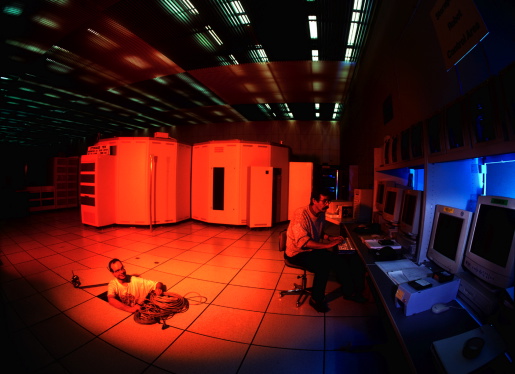
©Cern
Over the past 17 years, the World Wide Web has revolutionised the way we communicate, work and play. Now, the organisation that created it is working a new system called The Grid. By sharing computing power instead of just information, it could one day help create a giant, global computer more powerful than anything we could ever build individually. Let’s just hope game programmers can keep up…
So what is The Grid?
‘The Grid is a new take on the old idea of ‘distributed computing’. Some of your readers may know about programs like SETI@Home, which uses your home computer to help scan radio signals from outer space? The idea is that you can get more work done if you distribute it to different processors. The Grid is designed to do this on a global scale. By using high speed networks and so on, you can share data and processing power all around the world.’
So your home system could basically become a supercomputer?
‘Well, the idea is that you just plug into this thing and you get processing power and data storage on demand. The Grid would work out automatically where there is free storage space and processing power, then tap into this. That’s the vision. At the moment, it’s mainly businesses and organisations that are building their own grids, but people are working on ways to make sure they’ll all be able to link up together.’
How far along is the project?
‘Well, here at CERN we’re getting ready to start using something called the Large Hadron Collider, which is basically a giant particle accelerator that will smash beams of energy together and create conditions like in the Big Bang. These collisions will generate about ten petabytes a year – or 10 million gigabytes – which is nearly 1% of all the information that humans produce on the planet each year, including digital images, photos and what have you. So what we’re going to do is distribute the data to eleven major centres around the world.’
And these centres will then share information like the Internet?
‘Well, it will never be as visible as the Internet. One analogy is Google. Every time you click search, it divides the job up and scans through terabytes upon terabytes of information in less than a second – but you don’t notice this. The Grid will be the same, it’ll do all the legwork but after a while people will get used to it.’
So could The Grid become a giant global computer?
‘Well, I’m not one of these futurologists, but the key thing is high speed networks. In 1997 when people first started talking about grids they didn’t make sense, because at 100MB per second it wouldn’t work. Nowadays, with dedicated fibre-optic cables we can manage 10GB per second. At 10GB/sec the world changes quite fundamentally. You can send a 1GB file from London to Los Angeles in less time than it takes to download it to your hard disk. Of course, not everyone has a 10GB/sec connection, but that’s just a matter of time.’
This interview originally appeared in Dazed & Confused magazine. To find out more about The Grid, visit gridcafe.
Next time: The darker side of supercomputers.
Return to: SUPERCOMPUTERS PART 3: THE GRID
Social Web